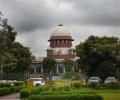
The Supreme Court has raised concerns about discrimination against persons with disabilities in employment, questioning the Centre on the lack of 'upward movement' for meritorious candidates. The court also ordered nationwide monitoring of care institutions for persons with cognitive disabilities.

The Supreme Court declined to initiate contempt action against a lawyer who hurled a shoe at the Chief Justice of India, citing the CJI's own refusal to proceed against him. The court is considering guidelines to prevent such incidents.
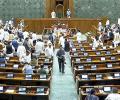
The Rajya Sabha, India's upper house of parliament, was adjourned on Monday without transacting any business due to a heated exchange between the ruling Bharatiya Janata Party (BJP) and the opposition Congress over the issue of reservations to Muslims in public contracts in Karnataka. The BJP accused Congress of seeking to amend the Constitution to provide reservations based on religion, while Congress asserted its commitment to protecting the Constitution. The debate centered around a statement by a senior Congress leader, who was reportedly advocating for changing the Constitution to provide reservations for Muslims.

The Supreme Court agreed to hear on Friday a public interest litigation (PIL) seeking inquiry and systemic reform in drug safety mechanisms in the wake of deaths of children in Madhya Pradesh and Rajasthan allegedly due to consumption of toxic cough syrups.

The Supreme Court on Monday reserved its order on issues pertaining to the renewal of the master rights agreement, which is necessary for holding Indian Super League (ISL) football matches this season.

'From the email on record placed before me, it is very difficult to conclude that AIFF had persuaded FIFA to send the emails to enable AIFF to seek for modification of the Constitution.

'Where rostering systems are automated and duty time software interfaces directly with DGCA, the assertion that they suddenly discovered crew shortages is simply implausible.' 'If adequate crew planning hasn't materialised within 12 to 24 months from inception, how will 45 days -- from December 5 to February 12 -- suddenly resolve matters?'
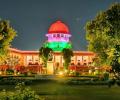
The Supreme Court of India has referred the matter of the Right to Education (RTE) Act's applicability to minority schools to a larger bench for adjudication, expressing concerns about potential misuse and fragmentation of the education system.

The Supreme Court is scheduled to pronounce interim orders on key issues related to the Waqf (Amendment) Act, 2025, including the power to denotify waqf properties.

The Supreme Court of India has emphasized the importance of conducting day-to-day trials, especially in sensitive cases, to ensure speedy justice as guaranteed by Article 21 of the Constitution. The court has directed high courts to form committees to address trial delays and revert to the practice of continuous trials.
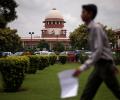
The Supreme Court is scheduled to pronounce interim orders on key issues related to the Waqf (Amendment) Act, 2025, including the power to denotify properties declared as waqf.
The Deepa Thoon controversy, if not allowed to die a natural death, could take the election focus away from the anti-incumbency impacting the DMK and into the secular space. Stalin would love to have it that way, all over again, after the three past elections, points out N Sathiya Moorthy.
The Supreme Court has agreed to reexamine the case of a death row convict punished for raping and killing a minor in 2008, focusing on whether sentencing guidelines were properly followed.

Activist Sharjeel Imam has moved the Supreme Court challenging a Delhi High Court order denying him bail in a case linked to the 2020 Delhi riots. The High Court had denied bail to several individuals, emphasizing that conspiratorial violence under the guise of protests cannot be allowed.
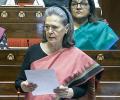
Congress Parliamentary Party chairperson Sonia Gandhi has criticized the Waqf (Amendment) Bill, calling it a 'brazen assault' on the Constitution and part of the BJP's strategy to keep society in a 'permanent state of polarization.' She also spoke out against the One Nation, One Election Bill, calling it a 'subversion of the Constitution.' Gandhi further accused the Modi government of ignoring the women's reservation bill and other demands for reservation, and of 'dragging the country into an abyss' where the Constitution will only exist on paper. She also criticized the government for limiting the speaking time of the Leader of the Opposition in Parliament and for not allowing discussions on important issues like the working of the defense and external affairs ministries and the challenges posed by China on the border.
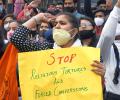
The Chhattisgarh high court has disposed of two petitions seeking the removal of hoardings prohibiting entry to pastors and 'converted Christians' in eight villages, holding that they were installed to prevent forced conversions through allurement or fraudulent means and cannot be termed as unconstitutional.
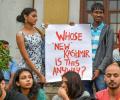
The Supreme Court on Monday dismissed a petition seeking a declaration that abrogation of Article 370 of the Constitution, which bestowed special status on the erstwhile state of Jammu and Kashmir, was constitutionally valid.
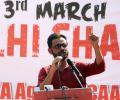
The Supreme Court on Monday sought the Delhi police's response on the bail pleas of activists Umar Khalid, Sharjeel Imam, Gulfisha Fatima and Meeran Haider in the UAPA case related to the alleged conspiracy behind the February 2020 riots in Delhi.
The application sought direction for 'X' to take down the video immediately to prevent further communal disharmony.

The Supreme Court has permitted the sale and bursting of green crackers in Delhi-NCR for Diwali, relaxing the ban on green firecrackers as a temporary measure from October 18 to 21. The court has asked pollution control boards to monitor pollution levels and file reports. The order also includes measures to prevent the sale of non-compliant crackers.

The Supreme Court on Friday adjourned to September 22 the hearing on bail pleas of activists Umar Khalid, Sharjeel Imam, Gulfisha Fatima and Meeran Haider in the Unlawful Activities (Prevention) Act (UAPA) case related to the alleged conspiracy behind the February 2020 riots in Delhi.
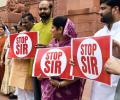
The Supreme Court has warned that it will set aside the special intensive revision (SIR) of electoral rolls in Bihar if any illegality is found. The court is reviewing the validity of the Bihar SIR and its potential impact on a similar exercise across India.

The Tamil Nadu government has urged the Supreme Court to dismiss the Presidential reference concerning the Governor's powers to assent to bills, arguing it is an 'appeal in disguise' to overturn settled law.

The Delhi High Court dismissed a plea seeking the removal of the graves of terrorists Mohammad Afzal Guru and Mohammad Maqbool Bhatt from Tihar Jail, citing the absence of any law prohibiting burial inside jail premises and the government's decision to maintain law and order.
The Supreme Court has scheduled a hearing for November 12 to address the statutory age of consent for adolescents, emphasizing the need for a continuous and comprehensive examination of the issue. The Centre defends the current age of consent, while an amicus curiae suggests lowering it.

A lawyer allegedly attempted to throw a shoe at Chief Justice of India BR Gavai during court proceedings. Security intervened, and the lawyer was removed from the premises. The CJI remained composed and continued with the proceedings.
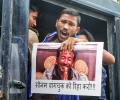
The Supreme Court has sought responses from the Centre and the Ladakh administration regarding the detention of climate activist Sonam Wangchuk under the National Security Act (NSA). Wangchuk's wife has filed a plea challenging the detention, claiming it violates his fundamental rights. The court has given the Centre and Ladakh administration 10 days to respond and has scheduled the next hearing for November 24.

Ashoka University professor Ali Khan Mahmudabad, previously booked for social media posts, has petitioned the Supreme Court for the release of his passport, a condition of his bail. The court will consider the plea on November 18.
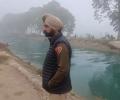
The Supreme Court of India has directed the governments of Punjab and Haryana to cooperate with the Centre in finding an amicable solution to the long-standing dispute over the Sutlej-Yamuna Link (SYL) canal. The court deemed the de-notification of land acquired for the canal in Punjab an "act of high-handedness" and emphasized the need to consider "wider ramifications" beyond legal considerations. The court has set August 13 for a further hearing if an amicable solution is not reached.

The Supreme Court on Friday said no one blamed the chief pilot of the Air India Dreamliner for the June 12 crash, which claimed 260 lives, and asked his 91-year-old father not to carry any emotional burden.

India's top-tier football league can no longer be owned or operated by private players as per the AIFF's new Constitution approved by the Supreme Court, which mandated the sport's apex body to take sole ownership of the product.

The Supreme Court has said that selling land or property is not a service under the Finance Act, 1994, so such sales cannot be charged with service tax.
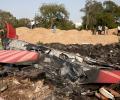
The Supreme Court has criticized the selective publication of a preliminary report on the Air India crash, calling it 'unfortunate and irresponsible'. The court raised concerns about privacy, dignity of victims' families, and the potential for biased narratives.
'Instead of the government and telecom operators solving the mess of their own creation, they're telling us we need to give access to our phones perpetually.'
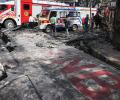
The Supreme Court has raised concerns about the preliminary report on the Air India crash and has asked for a more independent and thorough investigation.

A profile of B Sudershan Reddy, former Supreme Court judge and Opposition's vice presidential candidate, highlighting his career, judgments, and contributions to constitutional law.

The Supreme Court expressed displeasure over the Allahabad High Court's orders regarding the Banke Bihari Temple in Vrindavan, questioning the use of intemperate language against the Uttar Pradesh government and staying further proceedings.

The Supreme Court has sought responses from the Centre and Union Territory of Ladakh regarding the detention of climate activist Sonam Wangchuk under the National Security Act. Wangchuk's wife filed a plea seeking his release. The court has scheduled the next hearing for October 14.

The Bombay High Court has declared a pollution-free environment a constitutional right and criticized the Maharashtra government for failing to address the issue of air pollution in Mumbai. The court expressed its disappointment with the government's lack of initiative, stating that citizens should not suffer due to the inaction of authorities. The court highlighted the severe air pollution levels in Mumbai, especially along major roads, and ordered the traffic department to take immediate action to reduce congestion and improve traffic flow.

Vijay, despite the loud message from his delayed arrival at the road-show/stampede venue, and more so his continued inaccessibility for fans-turned-cadres after graduating from a super-star to a political party leader with electoral ambitions, refuses to change. Or, so it seems, observes N Sathiya Moorthy.
 © 2026 Rediff.com - Advertise with us - Disclaimer - Privacy Policy - Sitemap - Feedback - About us - Terms of use - Grievances